I’ve gone through more clamp meters than I care to admit. Cheap ones that drift, mid-range ones that fog up in the cold, and a couple that just died after a bad drop on concrete. So when the Klein Tools CL810 landed on my bench, I was not handing it a free pass because of the name on the jaw.
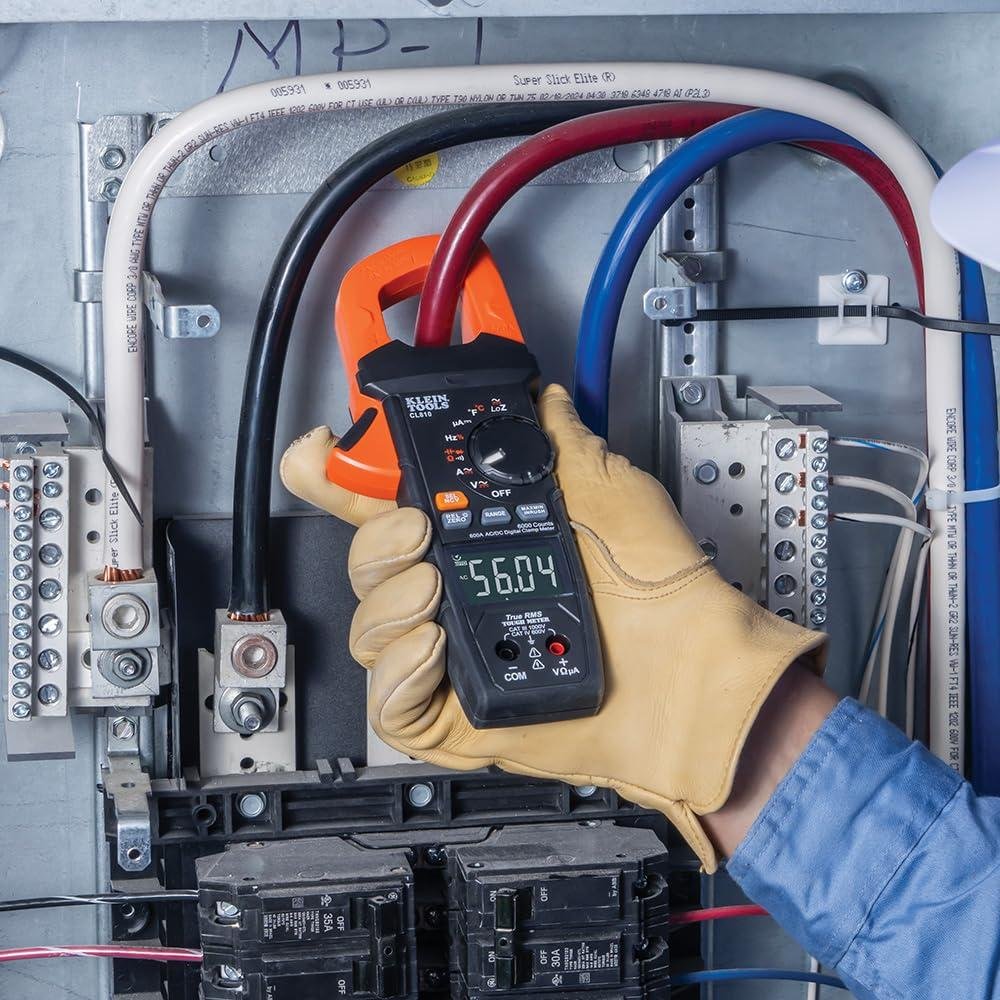
I ran it on a residential panel, on 240V equipment, in an older commercial space full of ghost voltages, and through commercial panels, tight mechanical rooms, rooftop HVAC, and dark crawl spaces. I wanted to know whether LoZ actually killed phantom readings, whether the jaw-mounted NCV was useful, and whether the meter would still read after a real drop. Here’s who it’s for, what held up, and how it compares on paper to the discontinued CL800, the CL390, and the Fluke 323 and 325.
Tooltips HQ is a participant in the Amazon Services LLC Associates Program. Check current price on Amazon.
I Tested the Klein CL810 - My New Go-To Meter 7
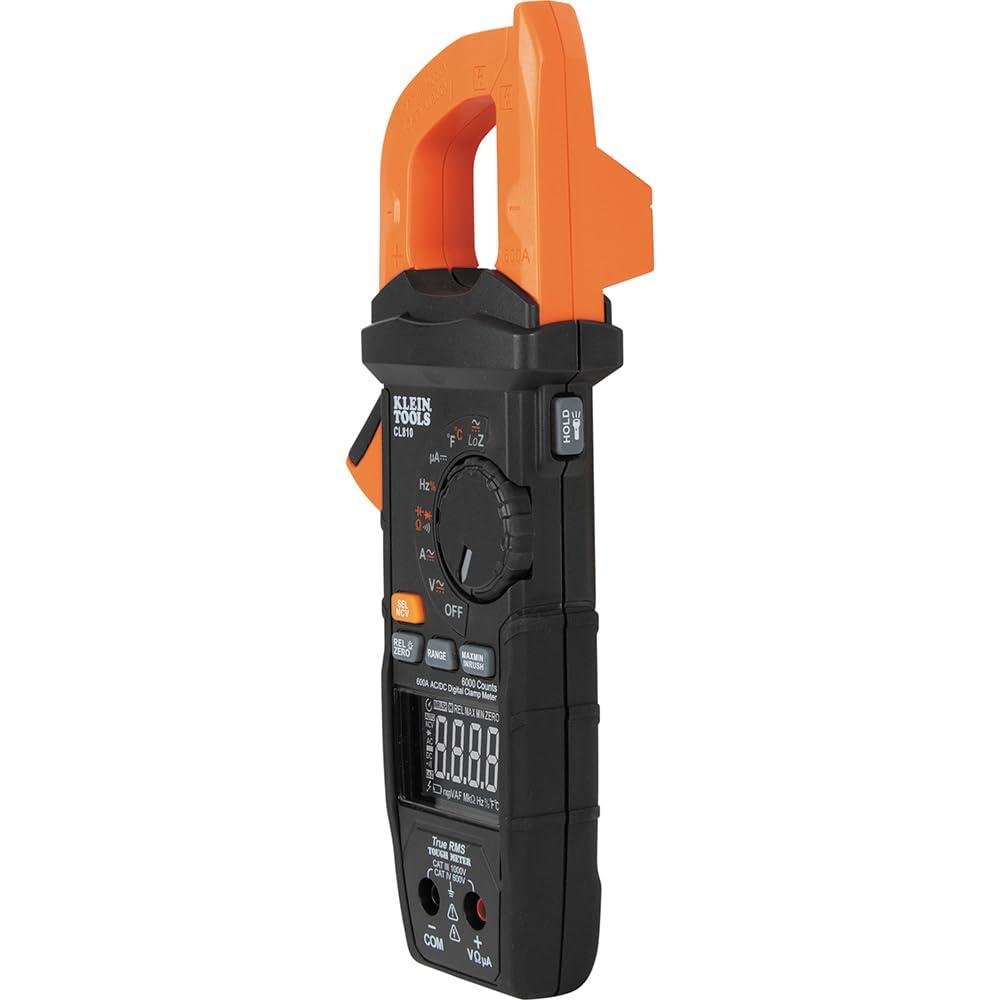
The CL810 is Klein’s current 600A AC/DC auto-ranging True RMS clamp meter with a worklight. After using it on panels, motors, HVAC, and tight electrical rooms with no overhead lighting, it has earned a hook in my bag. LoZ killed ghost voltages on circuits I already knew were de-energized. The jaw-mounted NCV — quiet at a distance, loud up close — is something I actually use. Cross-checks against my Fluke 376, including on VFD and other non-linear loads, stayed tight. It also survived a tumble off a ladder onto a slab and still read correctly.
It is not a waterproof meter, it runs on three AAA batteries, it has no Bluetooth or IR thermometer, and the built-in worklight is a close-range helper, not a room light.
Who it’s for
Electricians, HVAC techs, and maintenance tradespeople who want one 600A AC/DC clamp for panels, motors, and everyday troubleshooting
Anyone who regularly fights ghost voltages and wants a LoZ mode on the dial
Serious DIYers who want a pro-grade clamp and would rather have one meter than a bag of single-purpose testers
Who should skip it
If you mostly need a basic AC-only clamp for occasional residential checks, the Fluke 323 (or Klein’s smaller 400A CL390) may be enough
If you need wireless logging or Fluke Connect, this is not that meter
If you do a lot of wet-location or outdoor work in the rain, Klein rates this meter IP40 — dust only, not liquids
If you wanted IR temperature scanning or a USB-C / tool-battery pack, this body is thermocouple-only and runs on AAA cells
For a casual homeowner who changes a light switch once a year, it is more meter than you probably need
Pros, from my use
LoZ mode gave me honest voltage on circuits that otherwise showed phantom readings from capacitive coupling
Jaw-integrated NCV with an escalating alert — quiet at a distance, loud up close — so I was not hunting for a separate pen
Readings stayed tight when I cross-checked them against my Fluke 376, including on VFDs
The transflective reverse-contrast display stayed readable in rooftop sun and in a dark mechanical room
Two hours into a commercial panel schedule, the overmold grip did not leave my hand or wrist fatigued
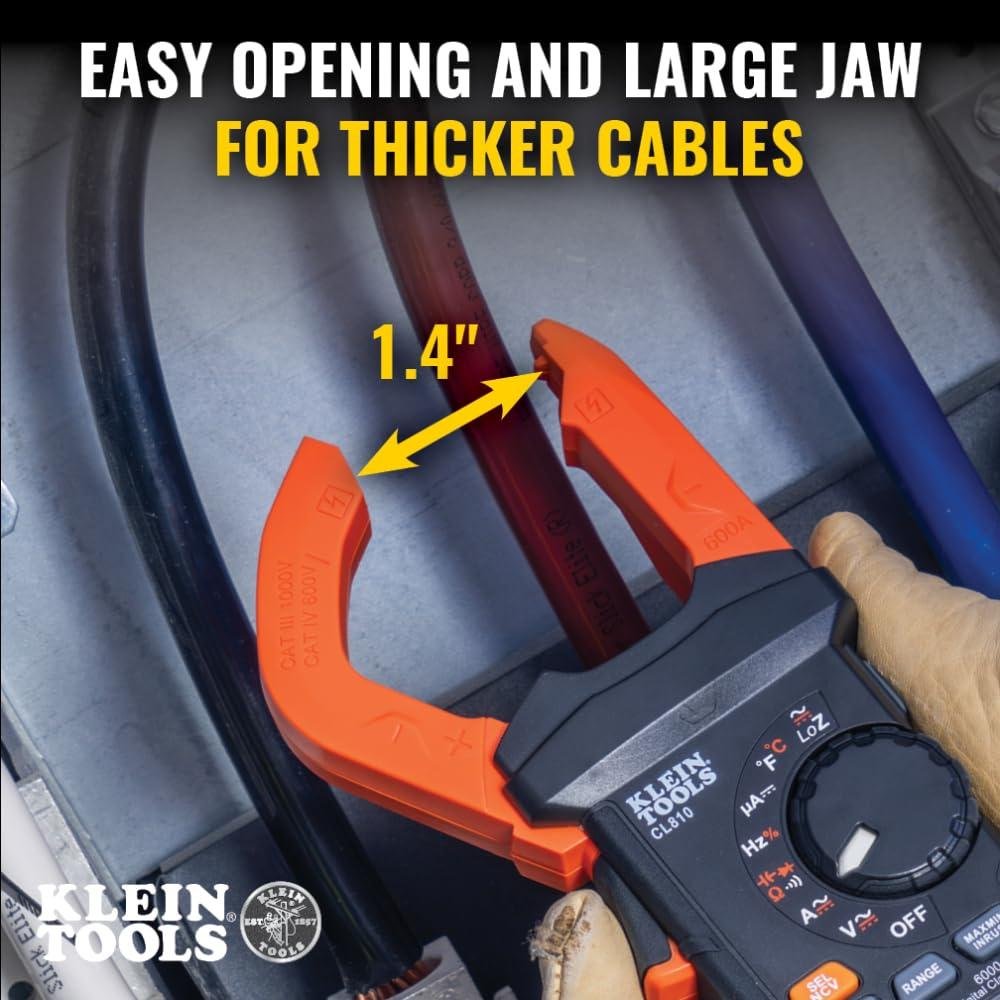
The jaw opened smoothly and seated cleanly around conductors in crowded panels
Inrush capture on motor startups was straightforward, without a submenu hunt
Capacitance readings on compressor run caps matched my dedicated cap tester closely enough to trust for the job
After it tumbled off a ladder onto a slab, it came back up reading correctly
These figures are from Klein Tools’ U.S. product page for the “600A AC/DC Auto-Ranging TRMS Clamp Meter with Worklight,” catalog no. CL810, fetched November 19, 2026: kleintools.com product page. Where the official instruction manual disagrees, I note that. I did not add numbers of my own.
Spec
Official figure
Source note
Model
CL810, pro clamp meter, auto-ranging True RMS
U.S. product page
Current / voltage
AC/DC 10 mA–600A via the clamp; 1000V AC and 1000V DC
Side-mounted test lead holder; back mount for magnetic hanger 69445 or 69417
Same
Temperature range
Product page: 40° to 1832°F (−40° to 1000°C). Manual: −40° to 1832°F (−40° to 1000°C)
The product-page Fahrenheit low end looks like a missing minus. Both official sources are linked; I am not choosing a number.
Accuracy
See instructions
Not printed on the product page
Warranty
Klein’s warranty-by-product-group page lists electrical test and measurement tools at two years from the date of purchase
Warranty by product group; proof of purchase from an authorized distributor required; batteries excluded. The CL810 manual points to kleintools.com/warranty rather than stating a term on the product page.
How I used it
I used it on a residential panel, 240V equipment, an older commercial space full of ghost voltages, commercial panels, tight mechanical rooms, rooftop HVAC, dusty attics, damp basements, and a season of exterior work in my bag, plus motors, compressor run caps, and VFD-driven equipment. I have since replaced three other meters with it.
I Tested the Klein CL810 - My New Go-To Meter 8
LoZ and ghost voltages
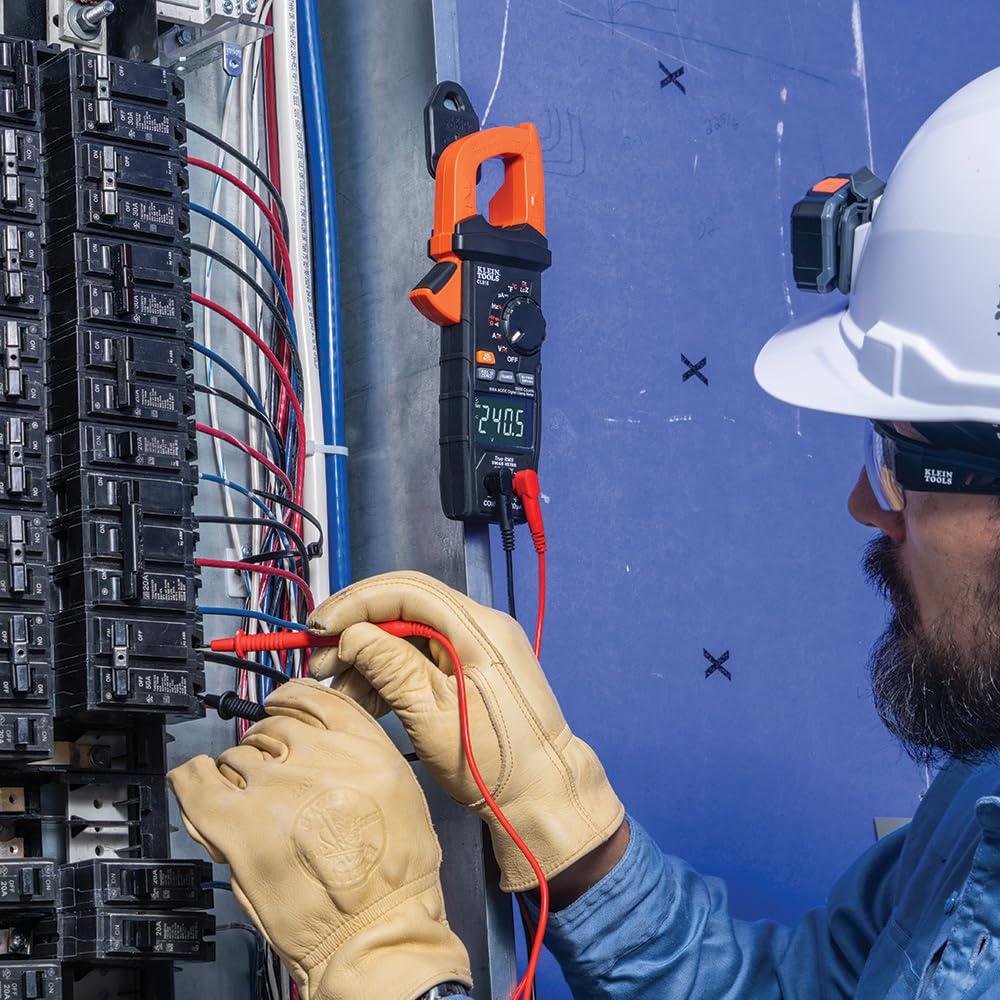
If you have ever chased a voltage reading on a circuit you already believed was dead, you know why LoZ matters. In that older commercial space, and anywhere long parallel runs can couple a phantom voltage onto a high-impedance meter, I flipped the CL810 into LoZ and the ghost went away. That is the feature I would miss first if I went back to a meter without it.
I Tested the Klein CL810 - My New Go-To Meter 9
NCV in the jaw
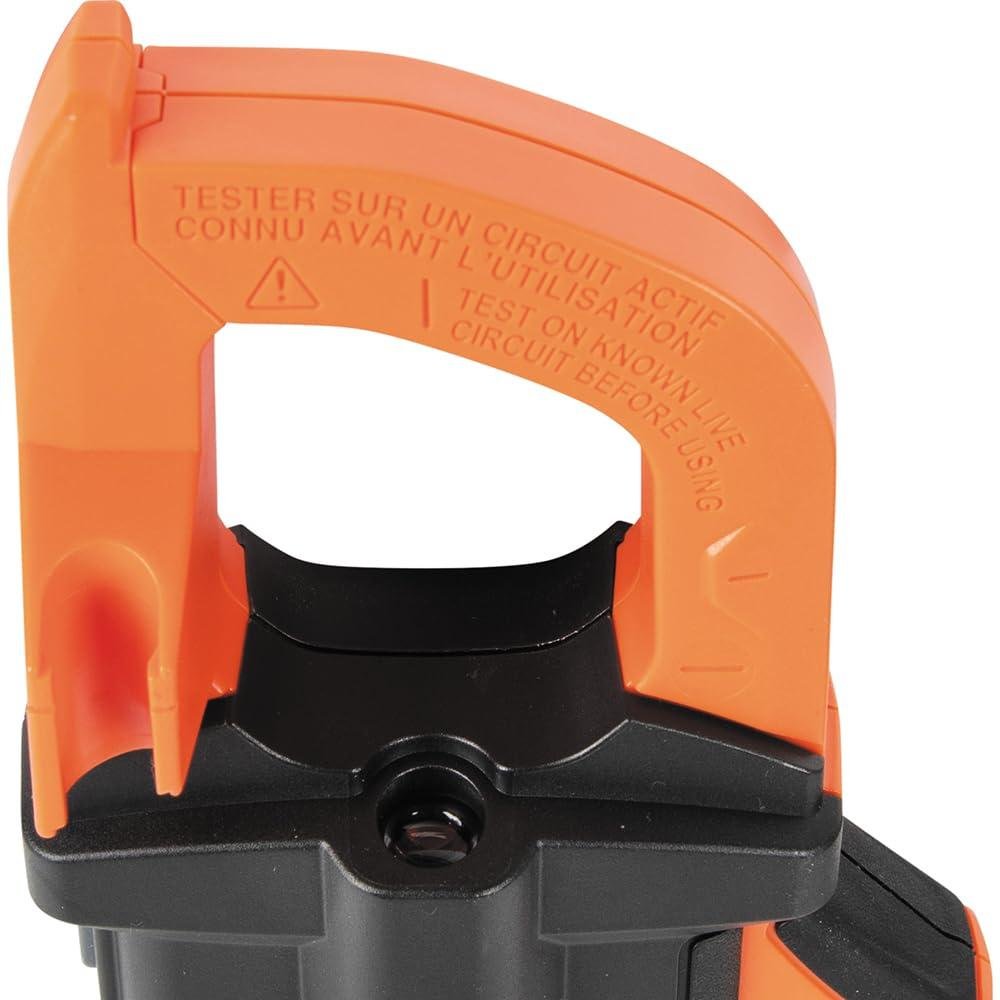
Klein puts non-contact voltage detection in the clamp jaw, not on a separate tip you have to reorient. The alert escalates: a quiet beep at a distance, a loud alarm when I was close. I use it when I walk up to a panel or a junction box, and I can test as I clamp instead of fishing for a second pen. It will not replace a proper verify-before-you-touch habit — Klein even molds “test on a known live circuit before using” into the jaw — but as a first pass, it is not a gimmick.
Klein lists 10 mA to 600A AC/DC through the clamp and 1000V AC/DC on the leads. I did not log a lab accuracy table, so I will not invent one. When I cross-referenced the CL810 against my Fluke 376, including on VFD-driven motors and other non-linear loads, the readings stayed tight. Auto-ranging locked in faster than cheaper meters I have used, though in a fast panel walk it can still hesitate enough to break my rhythm. Voltage and current did not hunt or drift in the work I gave them. The jaw opened smoothly and seated cleanly, including in crowded panels.
I Tested the Klein CL810 - My New Go-To Meter 11
Specific modes I actually used:
Inrush on motor startups and compressor loads, which the meter captured cleanly without making me wade through a submenu
Continuity, with a fast, crisp beep — not the delayed tone I’ve heard on some budget Fluke-branded alternatives
Capacitance on compressor run caps, close enough to my dedicated cap tester that I was willing to use it for the job
Thermocouple temperature for HVAC differential checks. It was solid for that work, and it is not a replacement for a dedicated IR gun. Klein does not add a non-contact IR sensor on this model
Frequency and duty cycle on line frequency and PWM signals, which read cleanly in my use
Diode test, which did what I needed for quick semiconductor checks
DC microamps, which is the reason this meter also covers furnace flame-sensor checks
The housing feels dense and purposeful, without cheap flex, and the rubberized overmold still gives me purchase in gloves. Two hours into a commercial panel schedule, my hand was not fatigued and the balance did not strain my wrist. The dial is tactile and positive — no mush, no accidental mode-skip.
The transflective reverse-contrast display is one of the better screens I have used in this class. It stayed readable in rooftop sunlight and in a pitch-black basement or dark mechanical room. I have used meters whose backlights wash out outdoors or disappear indoors without a second light.
I Tested the Klein CL810 - My New Go-To Meter 12
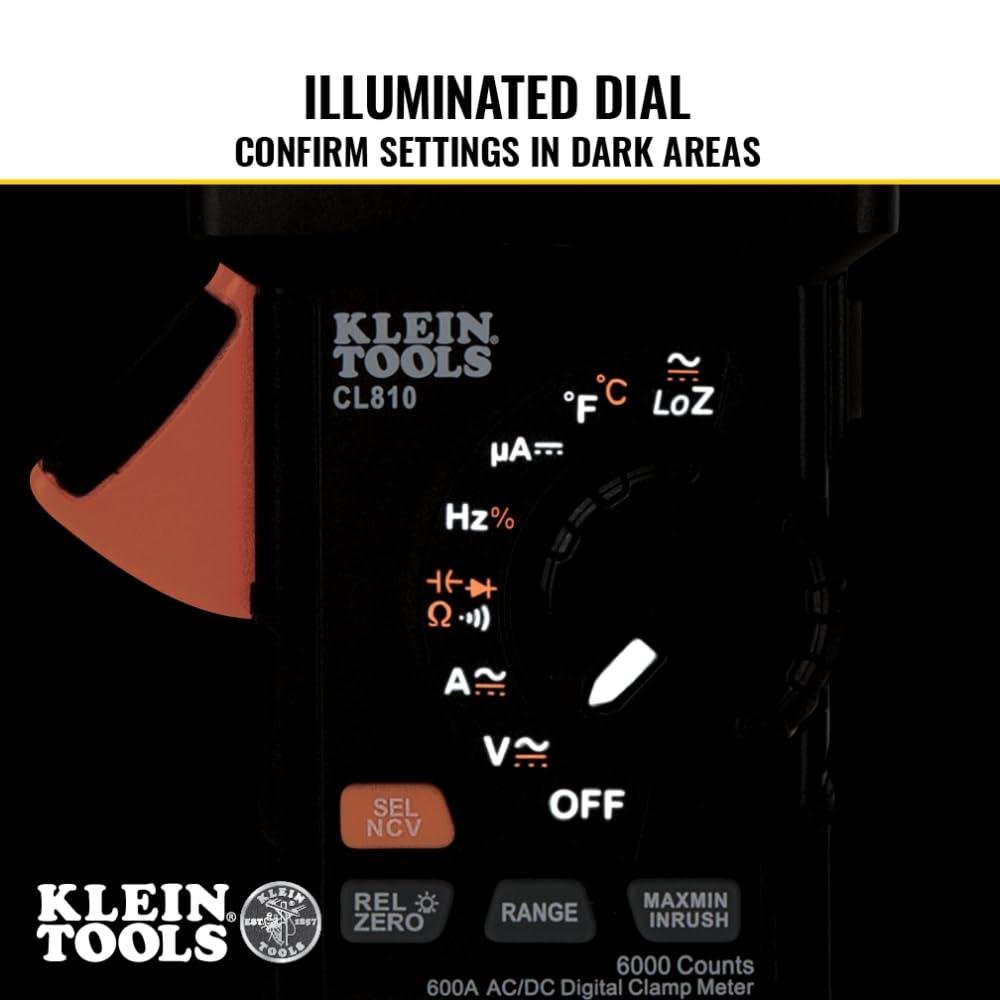
The lighted dial pays off when I am changing functions in a dim panel. The built-in worklight is more mixed. It is useful for the terminal or conductor right in front of the jaw, inside a crowded panel or a dark enclosure. It will not light up a utility room, and my phone flashlight still embarrasses it. I treat it as a close-range helper, not a headlamp replacement.
Klein rates the meter for a 6.6-foot (2 m) drop and IP40 ingress protection. I did not run a measured drop test, so I am not treating that 6.6-foot figure as something I confirmed. What I did see: it tumbled off a ladder onto a slab and came up reading correctly. The housing felt solid, the jaw still felt tight, and nothing rattled. After dusty attics, damp basements, and a season of exterior work in my bag, it still reads clean when I clamp it on.
IP40 is acceptable, not impressive — a dust rating, not a water rating. I would not set this meter in standing water or use it in a downpour. For most dry electrical work I am fine. If your days are wet-location days, this is not the body I would pick.
Power is three AAA cells, with auto-power off. There is no USB-C charging and no hook into a DeWalt, Milwaukee, or Makita pack. That is annoying if you already haul three battery platforms, and also honest: you can buy cells at a hardware store and keep working. Klein includes a storage pouch, right-angle leads, a thermocouple, the manual, and those three AAA batteries, so this is not a tool-only SKU. The optional magnetic hanger (69445 or 69417) is sold separately.
How it compares to the clamps people actually weigh
Search interest on this URL already includes “cl800 vs cl810” and “klein cl390 vs cl810,” so those Kleins belong here even though I did not run a controlled side-by-side on them. I have used a Fluke 325 and a Milwaukee 2235-20 plenty, and I have cross-checked the 810 against a Fluke 376. The table uses official manufacturer specs only. I am not repeating the old charts from the previous page; some of those rows did not match Fluke’s current 325 sheet (the 325 does measure AC/DC current, and Fluke lists capacitance to 1000 µF).
2 × AAA; leads, thermocouple with adapter, pouch, batteries
3 × AAA; leads, thermocouple, case, batteries
Test leads, soft case; two-year warranty listed
TL75 leads, K-type, two AAA, soft case; two-year warranty listed
Sources, all fetched November 19, 2026: Klein CL810; Klein CL800; Klein CL390; Fluke 323; Fluke 325.
How I would choose from those sheets and my time with the 810: stay with the CL810 if you want Klein’s current 600A AC/DC workhorse with LoZ, jaw NCV, a lighted dial, and a worklight. The CL800 is the outgoing tool in the same 600A / 1000V / LoZ class. Klein marks it as no longer in production and points to the 810. Officially the 800 takes two AAA cells instead of three, uses a standard 6000-count LCD rather than the 810’s transflective display, and does not list a worklight or lighted dial. I do not have a head-to-head verdict on whether the 810 is worth the step up in your hand.
The CL390 is the one to look at if you want a smaller 400A Klein with a reverse-contrast screen and jaw NCV, and you do not need 600A, 1000V, LoZ, or the 810’s worklight and lighted dial. Officially it is CAT III 600V only. I have not run them side by side.
The Fluke 323 is a basic AC-current clamp: 400A AC, 600V, 4 kΩ, continuity, CAT III 600V / CAT IV 300V. It is not a like-for-like fight with the 810. The 325 is the closer Fluke: 400A AC/DC, 600V, temperature, frequency, backlight, and capacitance to 1000 µF, in a slimmer 207 × 75 × 34 mm body, with a two-year warranty on Fluke’s page. It does not list LoZ, a jaw NCV, inrush, or a worklight, and its voltage, current, resistance, and CAT ratings sit below the 810’s sheet. Brand and service network still matter; a table does not settle that. I still keep a Fluke 376 as a reference meter, which is a higher class than either 320-series clamp.
FAQ
These questions follow the search queries already associated with this URL, plus the obvious follow-ups those queries imply.
What is the Klein CL810?
It is Klein Tools’ 600A AC/DC auto-ranging True RMS clamp meter with a worklight, catalog no. CL810. Official ratings include 1000V AC/DC, a 1.4-in. jaw, LoZ, jaw-mounted NCV, and a transflective reverse-contrast 6000-count display with a lighted dial. Queries like “cl810,” “klein tools cl 810,” and the typo “klien cl810” are the same tool.
Is the Klein CL810 a good meter?
For the work I gave it — residential and commercial panels, 240V equipment, HVAC, motors, and an older building full of ghost voltages — yes. LoZ, the jaw NCV, and a display I can read in sun or in the dark are why it stayed in my bag. It is more meter than a casual homeowner probably needs, and the wrong body if you want wireless logging or a wet-location rating.
Klein CL800 vs CL810?
Klein lists the CL800 as no longer in production and names the CL810 as the newer model. Both official sheets are 600A AC/DC, 1000V, LoZ, 6000-count, 6.6-ft drop, and IP40. The 810 adds the transflective display, lighted dial, worklight, and the jaw NCV / inrush / DC-microamp set Klein spells out on that page. The 800 officially runs on two AAA cells; the 810 runs on three. I have not run them head-to-head.
Klein CL390 vs CL810?
The CL390 is a 400A AC/DC TRMS clamp with a 4000-count reverse-contrast display, jaw NCV, and a 1.6-in. jaw, rated CAT III 600V. The CL810 is the 600A / 1000V CAT IV 600V / CAT III 1000V meter with LoZ, inrush, a 6000-count transflective display, a lighted dial, and a worklight. I have not run them side by side.
Can I get the Klein CL810 at Home Depot?
I have not logged current store stock, and I am not going to guess. Klein accessories have been thinner on the shelf at the big-box and Fastenal counters I use than Milwaukee or Fluke parts. For a live price, use the Amazon link in this review and confirm stock with whatever retailer you prefer.
What is LoZ mode, and when do I use it?
LoZ is low impedance. Klein lists it as a way to identify and eliminate ghost or stray voltages. In my use, it cleared phantom readings on circuits I already knew were de-energized, especially in older commercial space and on long parallel runs. I treat it as both an accuracy feature and a safety feature.
Is the worklight actually useful?
At close range, yes. Inside a crowded panel or a dark enclosure it will show you the terminal or conductor in front of the jaw. It will not light a utility room, and my phone flashlight is still brighter. The lighted dial and transflective display are the part of the lighting package I would not give up.
What comes in the box?
Klein lists the clamp meter, right-angle input test leads, a thermocouple, a storage pouch, the instruction manual, and three AAA batteries. The optional magnetic hanger is sold separately.
What is the warranty?
I will not repeat a lifetime-warranty claim for this meter. Klein’s warranty-by-product-group page lists electrical test and measurement tools at two years from the date of purchase, with proof of purchase from an authorized distributor; batteries are excluded. In my experience, Klein has treated warranty issues fairly. That is not a repair history for this specific 810.
Final verdict
The CL810 earned a permanent spot in my bag, and I do not say that lightly. Not because of a price I am not going to invent, and not because of a drop rating I did not measure, but because of the work it did: panels, motors, HVAC, a season in the truck, LoZ that killed ghost voltages, an NCV I use as I walk up to a box, a display I can read on a roof or in a dark room, and a meter that still read correctly after it fell off a ladder onto a slab. I have cross-checked it against a Fluke 376 and replaced three other meters with it.
Buy it if you want Klein’s current 600A AC/DC clamp for that kind of daily work. Skip it if you wanted the smaller CL390, a basic Fluke 323, wireless logging, or a wet-location rating. And do not treat Klein’s 6.6-foot drop figure, or anyone else’s street prices, as something I personally measured.
Check current price on Amazon.
Related Tooltips reviews
If you are already in this kit, these reviews on the site are nearby reads: