I’ve been a DeWalt guy for years. My shop and my truck are loaded with 20V MAX packs, so a 3/8-inch cordless ratchet that claims to run on those batteries is always going to get my attention. The tool in this review is the ACROPOW AC-RW01-DW — a third-party, tool-only, brushless ratchet sold on Amazon as ASIN B0CWPJ7115. It is not made by DeWalt. ACROPOW is upfront about that, and I’m going to be upfront too: the original version of this page repeated itself, used the wrong official numbers for the DeWalt and Milwaukee comparisons, and treated the no-load speed as 0–200 RPM. The Amazon listing this article links to lists 74 ft-lbs of torque and 0–250 no-load RPM. Those are the published numbers I am using here.
I used it on rusted brake-caliper bolts, suspension hardware, engine-bay work, under-dash fasteners, panel work, and a stretch of work under a truck and inside a panel box. Here’s who it’s for, what held up in that use, and how the published specs stack up against DeWalt’s DCF510B, DCF513B, and DCF503B, plus Milwaukee’s M12 FUEL 2557-20.
Tooltips HQ is a participant in the Amazon Services LLC Associates Program. Check current price on Amazon.
This ACROPOW Ratchet Runs on My DeWalt! 7
If you already own DeWalt 20V MAX batteries and want a brushless 3/8-inch cordless ratchet for running fasteners — not breaking seized lugs — the AC-RW01-DW is a practical add-on. In my use, it slid onto a DCB205 5.0Ah pack with no adapter, the variable trigger was easy to feather, the slim head got into a tight firewall area, and the rubberized grip held up through a long morning of panel work and teardown without my hand cramping or sliding. ACROPOW lists 74 ft-lbs and 0–250 RPM. That is enough for a lot of under-hood, suspension, HVAC, and assembly work. It is not a substitute for an impact wrench or a breaker bar.
I would treat it as a dedicated helper or a backup, not as the only ratchet I would stake a production schedule on. ACROPOW is not DeWalt, the listing does not spell out a warranty term the way DeWalt and Milwaukee do, and I do not have a dealer counter to walk into if the anvil or trigger fails later.
Who it’s for
DeWalt 20V MAX owners who want a tool-only 3/8-inch cordless ratchet that uses packs they already own
Mechanics, HVAC techs, and serious DIYers who need a speed tool for repetitive fastening in tight spaces
Anyone who wants the 3/8-to-1/2 adapter, 3/8-to-1/4 adapter, and 3-inch extension bar in the box, not as extras
Who should skip it
If you need to break seized lug nuts or corroded exhaust hardware, this is the wrong class of tool — grab an impact or a breaker bar
If you are not already on DeWalt 20V MAX, this is tool-only: no battery and no charger in the box
If you want a first-party DeWalt ratchet, a sealed-head design, interchangeable 3/8 and 1/2 anvils, or a stated 3-year limited warranty, look at the DCF510B or DCF513B
If you live on Milwaukee M12 and want that platform’s service network, the 2557-20 is the closer fit
If you need a factory 12V MAX tool, DeWalt’s DCF503B is a different platform entirely
Pros, from my use
It ran on the DeWalt 20V MAX packs I already own; I used a DCB205 5.0Ah pack and did not need a new charger
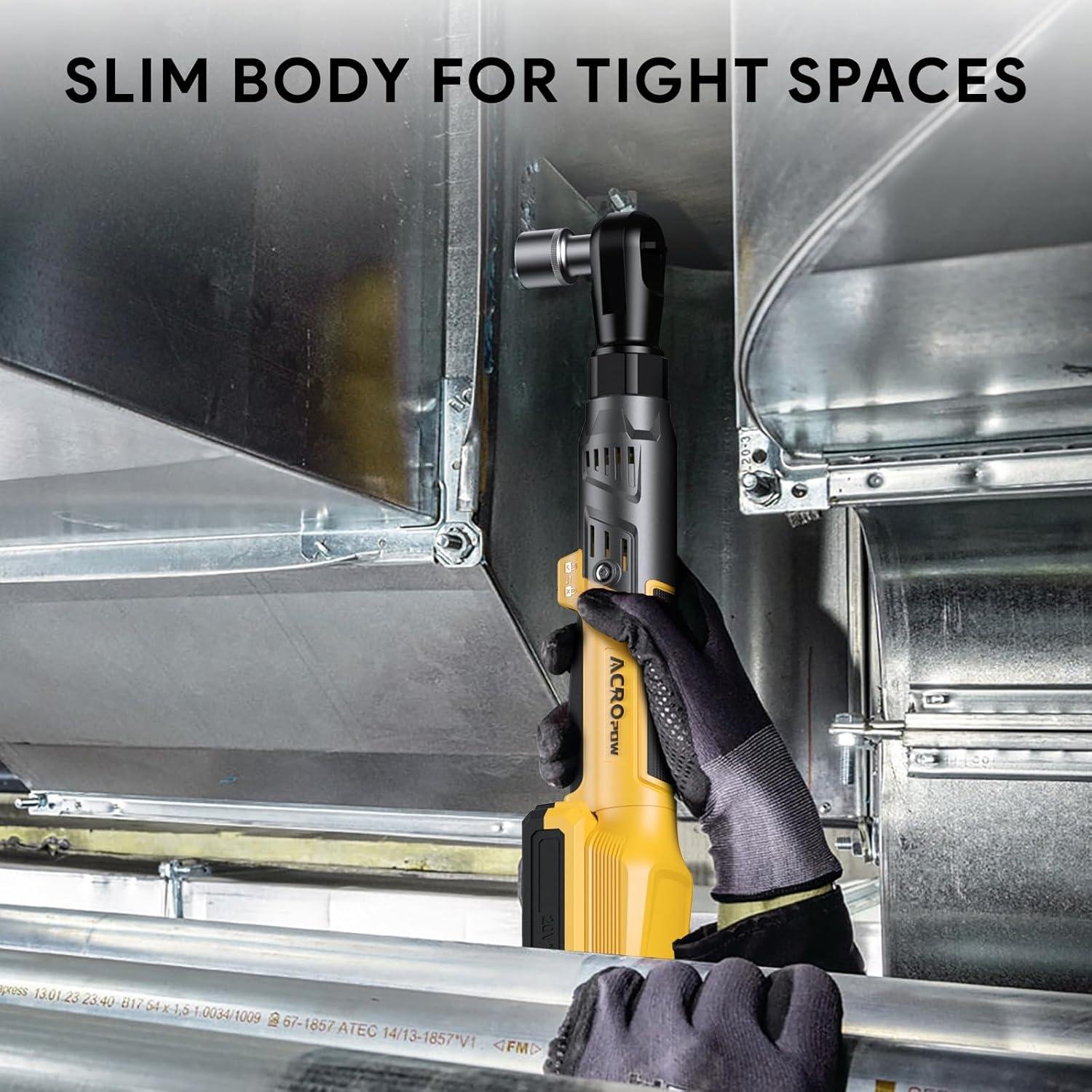
The low-profile head fit a firewall area that would have been a fight with a bulkier ratchet
The variable trigger was progressive and predictable — light pressure for threading, full squeeze to run fasteners
After two-plus hours and a long morning of panel work and teardown, my hand was not cramping or sliding
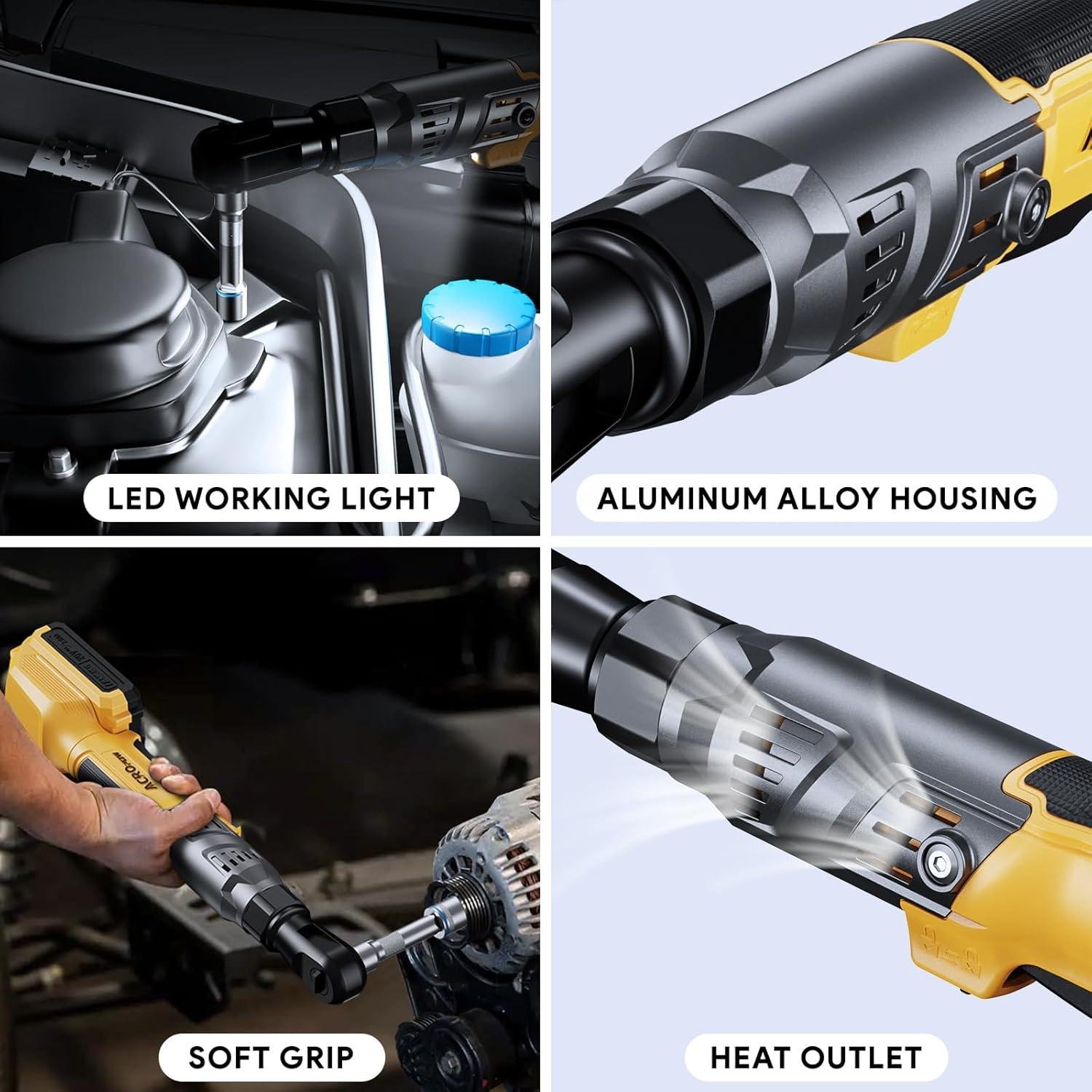
The aluminum housing felt solid, not hollow, and shrugged off shop fluid better than cheap plastic shells I’ve used
I could feel airflow at the heat outlet when I pushed it hard; after 45 minutes in a cramped engine bay, the housing was warm but not alarming
The onboard LED, which comes on with the trigger, was useful under a dash, in a junction box, and deep in an engine bay
The included adapters and 3-inch extension were the first things I grabbed, and they were useful, not filler
These figures come from the Amazon listing for ASIN B0CWPJ7115, model AC-RW01-DW. I did not independently dynamometer the torque or tach the no-load speed. ACROPOW also sells other 3/8-inch DeWalt-compatible ratchets, including 45 ft-lb listings, so match the ASIN if you are shopping from this review.
Spec
ACROPOW listing (B0CWPJ7115)
Model
AC-RW01-DW
Drive
3/8 in., with 3/8-to-1/2 and 3/8-to-1/4 adapters included
Published max torque
74 ft-lbs
Published no-load speed
0–250 RPM
Motor
Brushless
Housing
Aluminum alloy, with a rubberized soft-grip handle
Battery
Tool-only; listing says compatible with DeWalt 20V MAX packs including DCB200, DCB203, DCB204, DCB205, DCB206, and more; not made by DeWalt
In the box
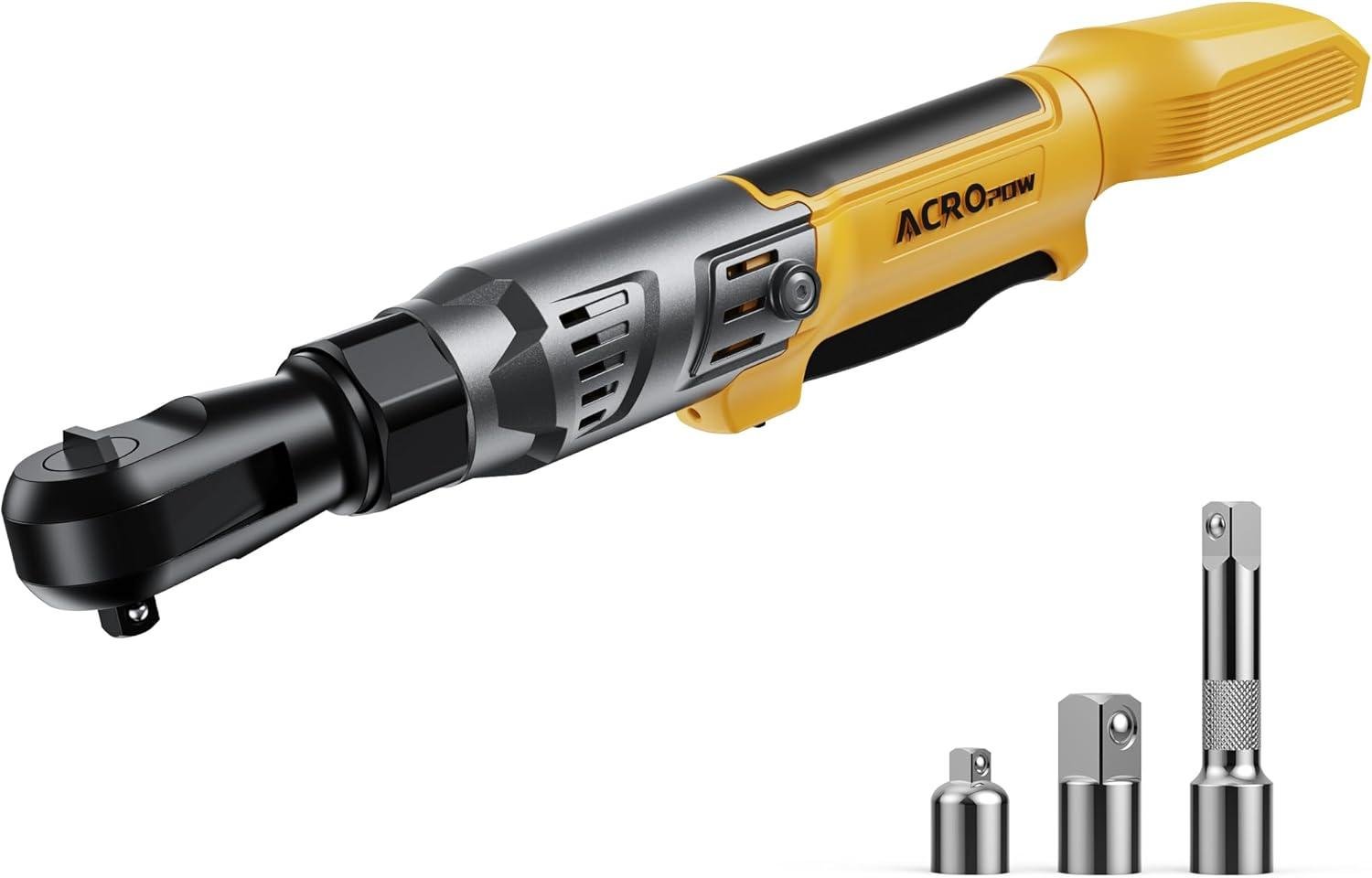
Ratchet, 3/8-to-1/2 adapter, 3/8-to-1/4 adapter, 3-inch extension bar, user manual
ACROPOW says the team will reply to questions or issues within 12 hours; a warranty term is not prominently spelled out
What’s in the box, and first impressions
This ACROPOW Ratchet Runs on My DeWalt! 8
The kit is simple, and that’s a compliment. In the box I had the 3/8-inch ratchet, a 3/8-to-1/2 adapter, a 3/8-to-1/4 adapter, a 3-inch extension bar, and the user manual. No battery and no charger — the listing calls that out clearly.
The aluminum housing felt solid in the hand, not like the lightweight, plasticky feel I sometimes get from third-party tools. The rubberized grip immediately signals comfort, and the slim, low-profile head looks designed for tight engine bays rather than as an afterthought. With a pack mounted, the balance sat naturally and did not feel top-heavy.
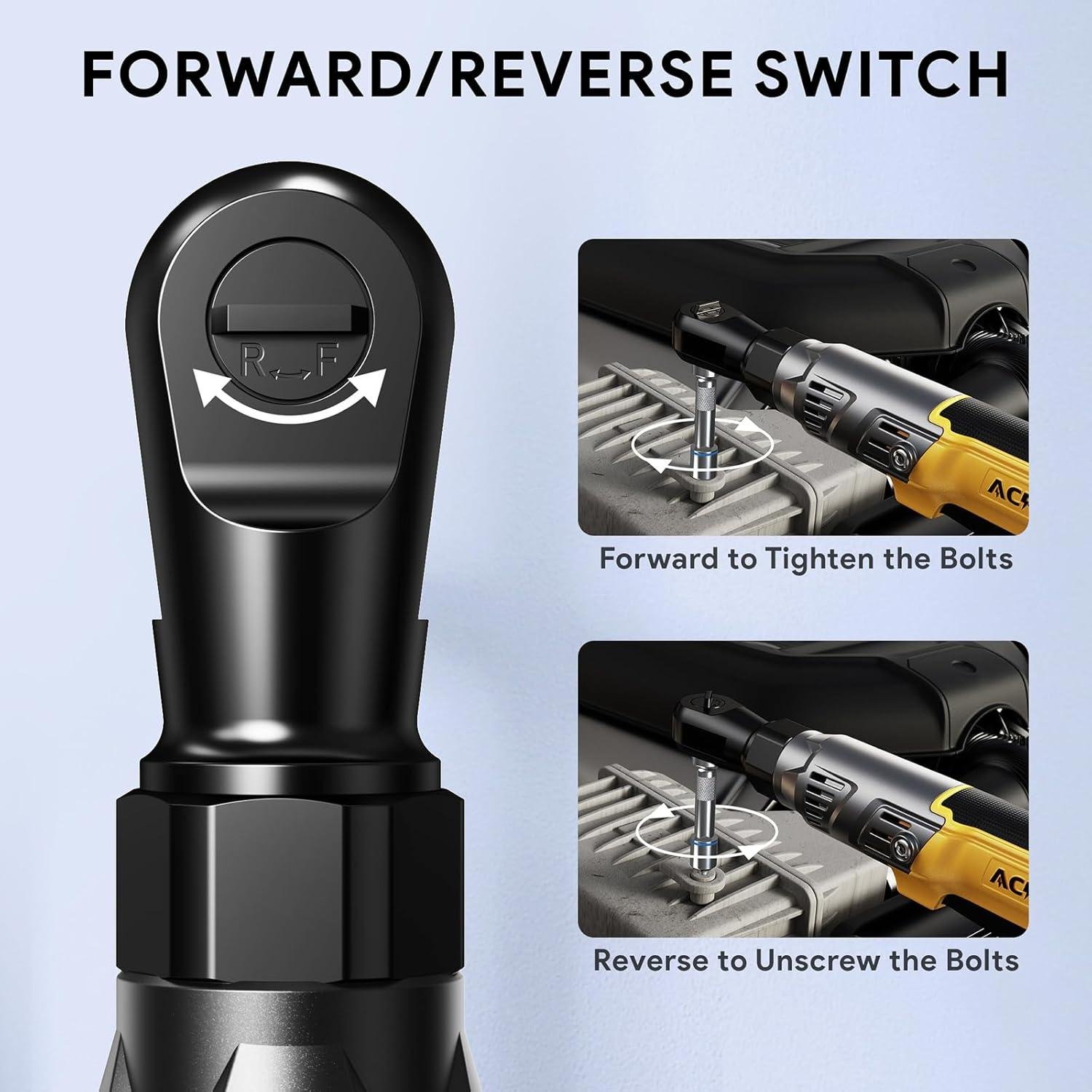
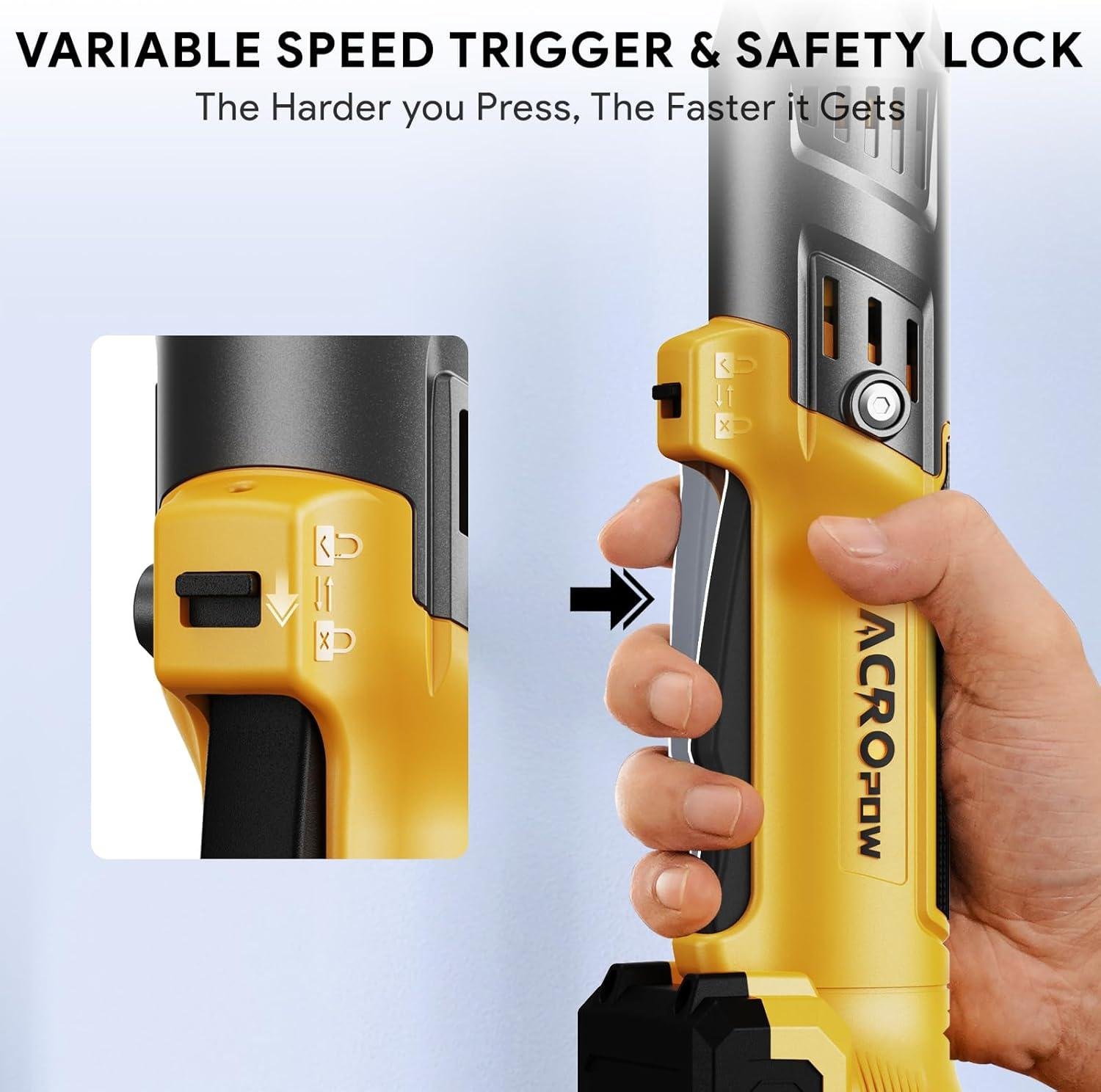
The forward/reverse switch is in a logical spot; I could flip it without repositioning my grip. The variable trigger has a smooth, progressive feel: light pressure for threading, a full press to run a fastener. The LED comes on with the trigger, which I prefer to a separate switch I have to hunt for in a tight spot.
How I used it
This ACROPOW Ratchet Runs on My DeWalt! 9
I did not take this on a lab tour. I put it on work I already had: rusted brake-caliper bolts, suspension hardware, engine-bay fasteners, under-dash and panel work, and time under a truck and inside a panel box. That is the job I want a cordless ratchet for — spinning fasteners I would otherwise crawl through with a hand ratchet, in places where a full-size impact is clumsy or overkill.
On those jobs, the published 74 ft-lbs did not feel like empty box copy. The output was consistent enough that I kept reaching for the tool. I still ran into the ceiling you should expect from a 3/8-inch electric ratchet: this is a fastener runner, not a stubborn-bolt killer. For a seized lug or a long-corroded exhaust bolt, I would not start here. I already keep an impact in the kit for that work, and you should too.
I ran it on a DeWalt 20V MAX 5.0Ah pack, the DCB205. Battery drain under sustained load was modest — better than I expected from a third-party tool on that pack. I did not instrument the amp draw, and I am not going to invent a runtime number, but I worked through a solid stretch of suspension work — tight loaded fasteners mixed with lighter threading — and an extended under-dash job under moderate load, and I was not burning through that 5Ah pack as fast as I expected.
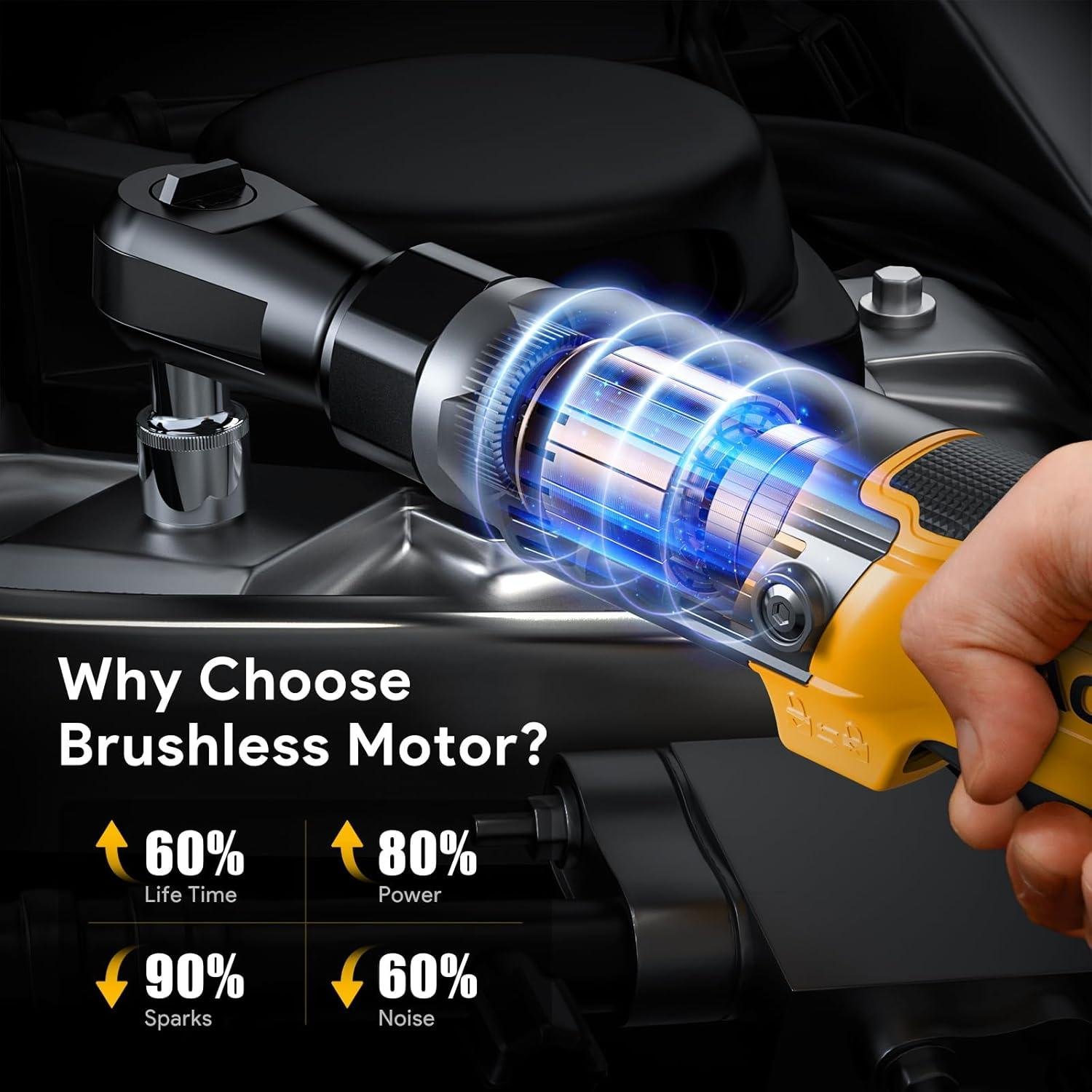
After a 45-minute session in a cramped engine bay, the housing was warm but never alarming, and the motor kept pulling. When I was pushing it hard, I could feel airflow at the heat outlet. The motor also ran quieter than brushed ratchets I’ve used in this general price range. I am not repeating the marketing percentages on one of the product graphics later in this review; I did not measure life, power, sparks, or noise against a brushed baseline.
This ACROPOW Ratchet Runs on My DeWalt! 10
The first thing I check on a ratchet is whether I still want it in my hand at hour six. The rubberized handle is not just a thin sleeve over a hollow shell. After a couple of hours of continuous use, and again after a long morning of panel work and teardown, my hand was not aching, cramping, or sliding the way it does on cheaper cordless ratchets that vibrate like a paint shaker. It is not as refined as Milwaukee’s comfort grip, but it is a long way from the bare-plastic imports I’ve used.
The aluminum body is a real point in its favor at this end of the market. I’ve dunked worse tools in shop fluid. The housing shrugged off oil and solvent better than the plastic shells on budget ratchets I’ve gone through, and it feels dense rather than cheap.
The compact head is not just catalog talk. I worked it into a firewall area that would have had me swearing at a regular ratchet for ten minutes. The slim body also helped in wheel-well and other tight spots where a bulkier head will not fit.
Speed control, the lock, and the LED
This ACROPOW Ratchet Runs on My DeWalt! 11
The variable-speed trigger is what separates a ratchet I will keep from one that stays on a shelf. I have used cordless ratchets that either crawled or sprinted, with nothing useful in between. This one is graduated and predictable, which matters when you are snugging a delicate aluminum fitting on one bolt and running a more ordinary fastener on the next. I am not going to quote a “full 200 RPM” feel as a measured result. ACROPOW lists 0–250 no-load RPM, and the trigger gave me useful control from a slow start up to a brisk run.
The safety lock needs a correction from the earlier version of this page, which described it as a lock for continuous operation so you could avoid holding the trigger on repetitive runs. The Amazon listing describes it differently: a safety trigger lock that “helps prevent accidental activation when applied.” That is the lock-off you see on a lot of cordless tools, and it is how I am treating the feature here.
The LED is placed well enough that it actually lights the work, not just the back of my glove. Under a dash, inside a junction box, and deep in an engine bay, it pulled its weight.
DeWalt 20V MAX compatibility
The compatibility is real in my use — no adapter, no workaround. I slid the tool onto a DCB205 and went to work. ACROPOW’s listing says the ratchet is compatible exclusively with DeWalt 20V MAX batteries, names DCB200, DCB203, DCB204, DCB205, and DCB206, then adds “and more,” and states that the tool is not manufactured by DeWalt.
I am not going to invent a full compatibility chart beyond those named packs. I did not test every 20V MAX battery DeWalt has sold, including FLEXVOLT packs, so I will not call a pack in or out if I did not click it on. Match the packs ACROPOW names, and confirm anything outside that list before you depend on it.
The value math only works if you already have the platform. If you do, you are buying a ratchet, not a charger and a starter pack. If you don’t, this is the wrong first tool into 20V MAX. And if you already live on Milwaukee M12 or M18, this is not a reason to switch camps.
How it compares
This ACROPOW Ratchet Runs on My DeWalt! 12
This is the section the original page got wrong, and it matters because people searching this URL are asking about the DCF510B versus the DCF513B and about Milwaukee. The earlier tables understated DeWalt’s published torque — in more than one place they put the DCF510B and DCF513B at 35 ft-lbs — and they also put the DCF503B on the 20V MAX platform. Those numbers do not match DeWalt’s current product pages. The comparison below uses official published specs. I did not run the DeWalt and Milwaukee ratchets on the same fasteners for this refresh.
Spec
ACROPOW AC-RW01-DW
DeWalt DCF510B
DeWalt DCF513B
Milwaukee 2557-20
Published max torque
74 ft-lbs (Amazon listing)
75 ft-lbs MAX
70 ft-lbs MAX
Up to 55 ft-lbs
Published no-load speed
0–250 RPM (Amazon listing)
0–300 RPM
250 RPM (DeWalt’s DCF513 kit page)
200 RPM
Drive
3/8 in., plus 1/2 and 1/4 adapters in the box
Interchangeable 3/8 and 1/2 in. anvils; sealed head
3/8 in.
3/8 in.
Motor
Brushless
Brushless
Brushless
Brushless
Battery platform
Third-party, for DeWalt 20V MAX (tool only)
DeWalt 20V MAX (tool only)
DeWalt 20V MAX (tool only)
Milwaukee M12 (tool only)
Housing, as published
Aluminum alloy
Glass-filled nylon; sealed head
Glass-filled nylon; compact / low-profile head
Investment-cast steel yoke; low-profile head
Warranty, as published
Reply-within-12-hours note on the listing; term not prominently spelled out
On published torque alone, the ACROPOW’s 74 ft-lbs sits next to the DCF510B’s 75 and a little above the DCF513B’s 70. That is a much closer race than the old tables implied, and it is not a reason to say this tool “outperforms” the DeWalt ratchets. What you are buying is a lower-priced third-party body that uses 20V MAX packs you may already own, plus the adapters and extension in the box. What you are giving up is the DCF510B’s sealed head and interchangeable anvils, the DCF513B’s compact ATOMIC packaging, and a first-party warranty and parts path.
The DCF503B belongs in this conversation because older copy compared this ACROPOW to it, but it is not a 20V MAX tool. DeWalt’s DCF503B page lists a 12V MAX brushless 3/8-inch ratchet with 60 ft-lbs of MAX torque, and the manual for that family lists a 0–250 RPM no-load range. If you already live on 12V MAX, that is the DeWalt to look at — not a reason to mix this ACROPOW into a 12V kit.
Against Milwaukee’s M12 FUEL 2557-20, the published numbers favor the ACROPOW on paper: 74 ft-lbs and 0–250 RPM versus 55 ft-lbs and 200 RPM. Milwaukee’s case is the M12 system, the steel yoke, the fuel gauge, and first-party service. If you already own M12 packs, stay there. If you already own DeWalt 20V MAX packs, this ACROPOW is the one that uses what you have.
I still would not use any of these cordless ratchets as a torque wrench. DeWalt even says that in the DCF510 and DCF503 manuals: these are light-duty fastening tools, and you should finish critical fasteners with a calibrated torque wrench.
FAQ
Which batteries are compatible with the ACROPOW ratchet?
ACROPOW’s listing says this SKU is compatible with DeWalt 20V MAX batteries, names DCB200, DCB203, DCB204, DCB205, and DCB206, and adds “and more.” It also says the tool is not made by DeWalt, and it ships with no battery and no charger. In my use, a DCB205 5.0Ah pack clicked on and ran with no adapter. I have not verified every 20V MAX pack, so if yours is outside that named list, confirm it before you buy.
Is ACROPOW a DeWalt tool?
No. ACROPOW is a third-party brand. The ratchet is designed to accept DeWalt 20V MAX packs, which is useful if you already own them. That is not the same as buying a DCF510B or DCF513B, and it does not include DeWalt’s 3-year limited warranty, 1-year free service, and 90-day satisfaction terms.
How does the ACROPOW compare to the DeWalt DCF510B and DCF513B?
On published torque they are close: 74 ft-lbs for the ACROPOW, 75 ft-lbs MAX for the DCF510B, and 70 ft-lbs MAX for the ATOMIC DCF513B. The DCF510B adds interchangeable 3/8 and 1/2-inch anvils, a sealed head, and 0–300 RPM. The DCF513B is DeWalt’s compact 3/8-inch 20V MAX option; the kit page lists 250 RPM. Both DeWalt tools carry the 3-year limited warranty package. The ACROPOW’s edge is price positioning and the adapters plus 3-inch bar in the box, not a hidden torque advantage.
How does it compare vs. Milwaukee?
The current Milwaukee 3/8-inch M12 FUEL ratchet is the 2557-20, listed at up to 55 ft-lbs and 200 RPM, with a steel yoke, LED, and fuel gauge. Milwaukee also lists 11.8 inches and 2.8 pounds with a battery installed (battery not included). If you already own M12 packs, that is the cleaner ecosystem choice. If you already own DeWalt 20V MAX packs, the ACROPOW uses what you have. I did not run the two tools head-to-head on the same fasteners.
Is 74 ft-lbs enough for real work?
For running fasteners in automotive work, HVAC installs, mechanical assemblies, under-dash and engine-bay jobs, and tight construction fastening, the listed 74 ft-lbs was enough in my use. It is not a breaker bar or an impact. I would not use it to break loose a seized lug nut on a pickup. Keep an impact in the kit for that, and finish torque-critical fasteners with a torque wrench.
Does it come with a battery and charger? What’s in the box?
No battery and no charger. You get the 3/8-inch ratchet, a 3/8-to-1/2 adapter, a 3/8-to-1/4 adapter, a 3-inch extension bar, and the user manual. In my use those extras mattered: larger sockets on the 1/2-inch adapter, smaller sockets on the 1/4, and a little extra reach with the 3-inch bar.
What’s the warranty?
The listing I used does not prominently spell out a warranty length. ACROPOW says the team will reply to questions or issues within 12 hours. That is not DeWalt’s published 3-year limited warranty, 1-year free service, and 90-day satisfaction guarantee. If the anvil or trigger fails later, you are dealing with a third-party seller and the return policy you bought under, not a DeWalt service center. Keep the receipt.
Final verdict
I came in skeptical, and I still will not pretend this is a DeWalt or a Milwaukee. After using it on real fasteners in tight automotive and mechanical spaces, it earned a spot as a helper in my 20V MAX kit. The brushless motor, slim head, grip, and included adapters are why I kept reaching for it. The listed 74 ft-lbs sits in the same neighborhood as DeWalt’s own 20V MAX ratchets on paper, and it was enough for the running-fastener work I gave it.
I would buy it again as a backup ratchet if I already had 20V MAX packs on the shelf. I would not make it my only ratchet on a demanding commercial job, and I would not buy it to start a battery platform. For first-party support, a sealed head, or an interchangeable anvil, I would look at the DCF510B. For a compact factory 20V MAX ratchet, the DCF513B. For an M12 kit, Milwaukee’s 2557-20.
If you are already on DeWalt 20V MAX, I also wrote up the DeWalt DCD801B after using that drill on framing, cabinets, and electrical rough-in. And if your work includes chasing ghost voltage, my take on the Klein CL810 clamp meter is here.
Check current price on Amazon.
ToolTipsHQ.com is reader-supported. As an Amazon Associate, I earn from qualifying purchases at no extra cost to you.